Product Discovery
Appointments
Rethinking a legacy appointments system around how healthcare teams actually organise work.
Year :
2026
Industry :
Healthcare
Company :
OneAdvanced

Problem :
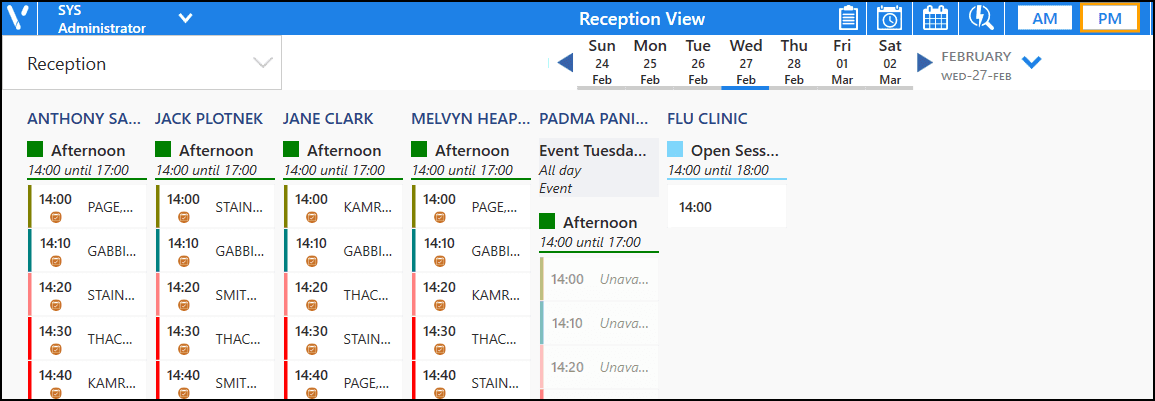
The existing product had been designed around a traditional appointment-book model and no longer reflected the variety of work happening within modern healthcare teams. Years of development had created established workflows and workarounds that users depended on, but which weren't necessarily appropriate foundations for a new product.
A particularly important example was task management. Because there wasn't an effective way to assign certain pieces of work, practices were creating appointment slots and using them as tasks. What initially appeared to be an appointments problem therefore pointed towards a much broader need: a way of managing different types of activity involving patients, clinicians and practice staff.
Solution :
I reframed the product around the concept of an interaction rather than treating every piece of work as an appointment. An interaction could represent different activities while sharing a consistent underlying structure, allowing the product to grow beyond traditional appointment booking.
From that model, I designed the day view, booking and creation workflows, clinician schedules, status behaviour and patient context. I also explored how the interface could adapt for different healthcare environments while retaining consistent interaction patterns.


Challenge :
The challenge was separating genuine user needs from behaviours that existed because of limitations in the legacy software. Simply reproducing every existing workflow would have carried decades of product constraints into the new experience.
Research also showed that the context mattered enormously. Primary care and urgent care could share underlying concepts while operating very differently day to day. I needed to find a model flexible enough to support these environments without creating an interface so generic that it became difficult to use.
Summary :
Appointments was an opportunity to rethink a core healthcare product that had existed in various forms for more than two decades. Rather than recreating the legacy system with a modern interface, I explored how appointment management had evolved across primary and urgent care and what teams actually needed from the next generation of the product.
Through site visits, interviews and workflow mapping, the project evolved from an appointments redesign into a broader piece of interaction design. One of the most important discoveries was that practices were using appointment books to manage work that wasn't an appointment at all.

More Projects



Product Discovery
Appointments
Rethinking a legacy appointments system around how healthcare teams actually organise work.
Year :
2026
Industry :
Healthcare
Company :
OneAdvanced
Problem :
The existing product had been designed around a traditional appointment-book model and no longer reflected the variety of work happening within modern healthcare teams. Years of development had created established workflows and workarounds that users depended on, but which weren't necessarily appropriate foundations for a new product.
A particularly important example was task management. Because there wasn't an effective way to assign certain pieces of work, practices were creating appointment slots and using them as tasks. What initially appeared to be an appointments problem therefore pointed towards a much broader need: a way of managing different types of activity involving patients, clinicians and practice staff.
Solution :
I reframed the product around the concept of an interaction rather than treating every piece of work as an appointment. An interaction could represent different activities while sharing a consistent underlying structure, allowing the product to grow beyond traditional appointment booking.
From that model, I designed the day view, booking and creation workflows, clinician schedules, status behaviour and patient context. I also explored how the interface could adapt for different healthcare environments while retaining consistent interaction patterns.
Challenge :
The challenge was separating genuine user needs from behaviours that existed because of limitations in the legacy software. Simply reproducing every existing workflow would have carried decades of product constraints into the new experience.
Research also showed that the context mattered enormously. Primary care and urgent care could share underlying concepts while operating very differently day to day. I needed to find a model flexible enough to support these environments without creating an interface so generic that it became difficult to use.
Summary :
Appointments was an opportunity to rethink a core healthcare product that had existed in various forms for more than two decades. Rather than recreating the legacy system with a modern interface, I explored how appointment management had evolved across primary and urgent care and what teams actually needed from the next generation of the product.
Through site visits, interviews and workflow mapping, the project evolved from an appointments redesign into a broader piece of interaction design. One of the most important discoveries was that practices were using appointment books to manage work that wasn't an appointment at all.